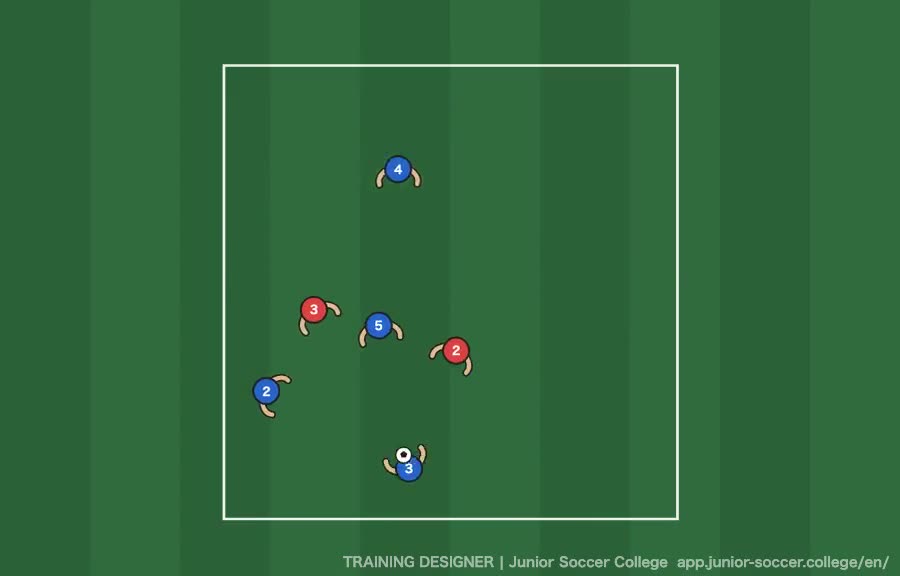
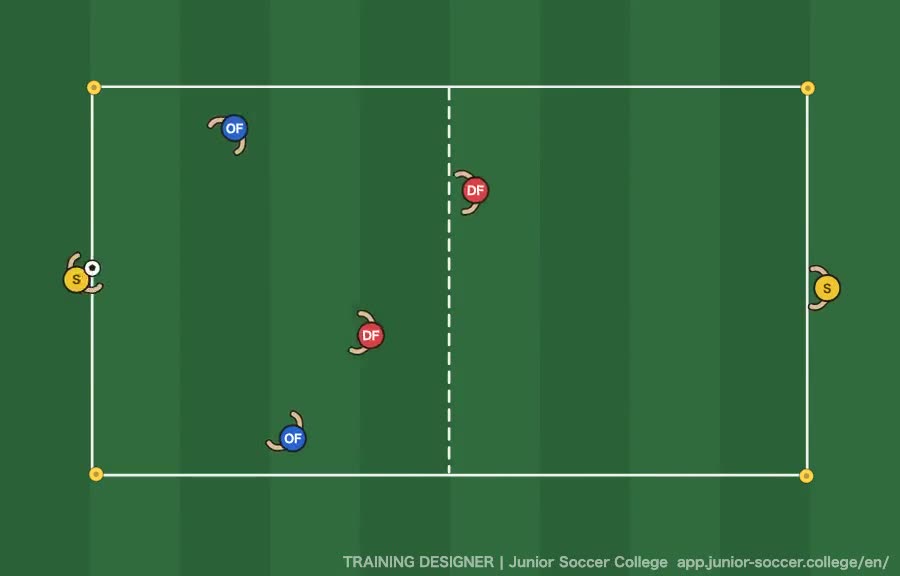
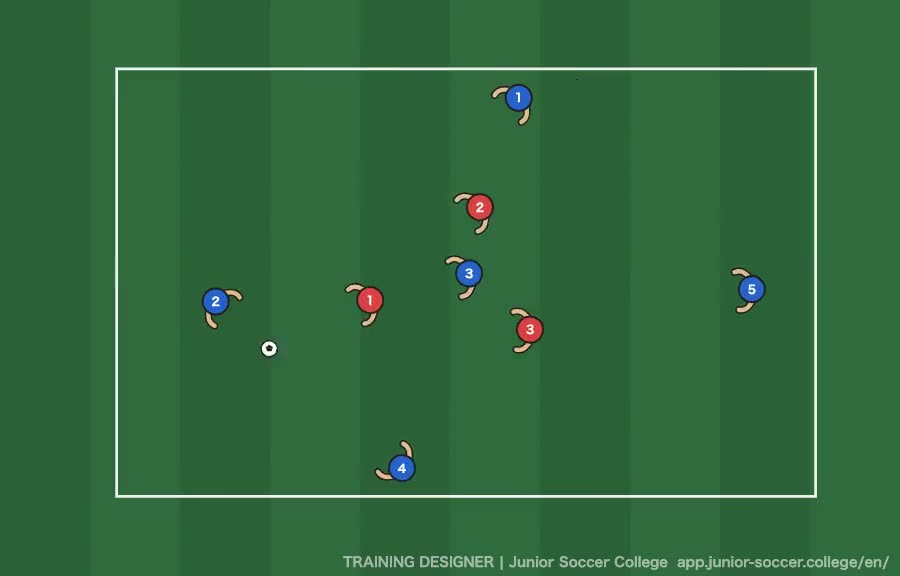
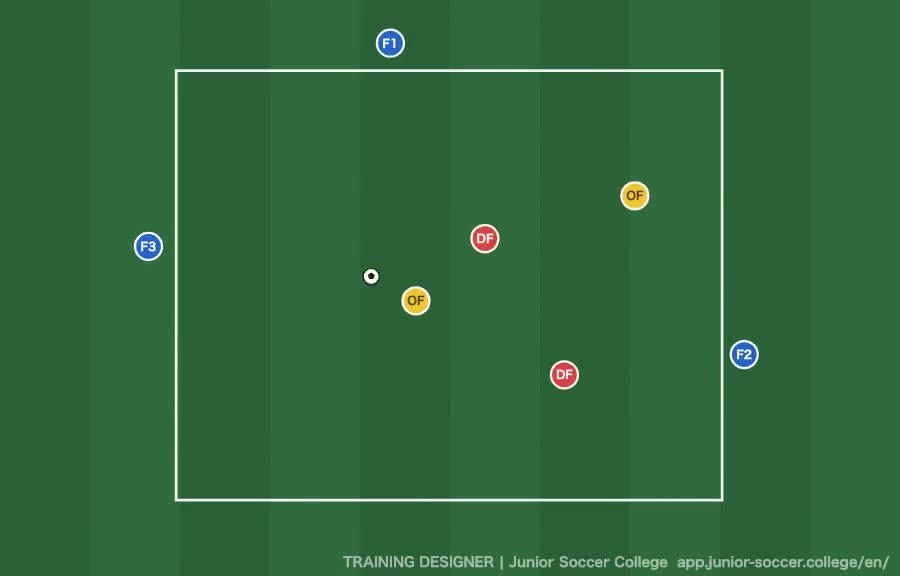
2v1 + 2v1 Rondo (Directional)
From the start of build-up (salida de balón) to progression with a numerical advantage
Use this when…
- In build-up, centre-backs and other players can't progress well even when they have a numerical advantage.
- Players in the back line can't choose between passing and dribbling.
Setup & rules
- Inside each grid it is 2v1
- Neither defenders nor attackers may enter the other grid
- Progress by passing to your teammates in the other grid
- After progressing, repeat in the opposite direction
- When the defender wins the ball, attack and defence switch
Key factors
- Get past the opponent's line with an oriented control (in a tight space, when you can't get past through positioning, use an oriented control to get beyond the opponent's line and progress)
- Make the defender think pass with your body shape, then get past with a dribble (turn your body towards your teammate so the defender has to think about cutting the pass — this helps open space for the dribble. Adding a kicking feint makes the defender more likely to bite on the pass)
- Secure space to play in (if the defender gets too close, dribbles and passes get caught more easily. It's important to decide before they close you down, so you have time)
- When closed down, turn or dribble while protecting the ball (if you do come under pressure, protect the ball, e.g. by screening, and link it to the next action. The key point is not to cut back carelessly and get caught)
- Beyond these, smaller problems will appear depending on the level, so set key factors each time
Progressions
- There is no need to restrict the age strictly; adapt to the players' level
- With, for example, 7 players, add a floater or organize the rotation cleverly
Kazu's notes FROM THE COACH
(1) Progressing from a numerical advantage (by splitting it into 2v1 instead of a 4v2 rondo, players get a picture of progressing from a numerical advantage. With less pressure and a lower load, they can learn to escape the press)
(2) The picture of finding the free player in midfield (after beating the defender with a dribble or pass, look for the free player in midfield. This is the prototype of a centre-back receiving from the goalkeeper, escaping the press and playing into midfield — building the base of fundamental technique and tactical decision-making). Coaching point: (1) if dribbles to beat a defender (regate) increase, help players understand the importance of progressing the ball safely and reliably
(3) Read the defender's movement and understand the logic of when to pass and when to dribble (make players aware of moving the opponent with body shape and small feints, and playing while holding the initiative)
Use this drill in your own session
Download it and open it in TRAINING DESIGNER — a free drill designer and session planner in your browser. Edit the diagram, change the numbers, add it to a session, and export as PDF, GIF or video.
In the app: menu → “Import external data” → choose the downloaded file. No sign-up needed.One idea a week from Japanese youth football
A free weekly essay on how kids actually learn the game — complexity, the ecological approach, and what 30 years on Japanese grassroots pitches taught me.
Related drills