Training Library › Defending
8v4 Possession (Directional) — Winning the Ball with Organized Pressing
Organized pressing (covering and sliding)
Players: 4+4+4 floatersArea: about 30×40 mAge: U-11 and upTime: 20 minPhase: Defending
Setup & rules
- Position players as in the diagram. It is actually 8v4, but with rotation in mind it is set up as 4v4 + 4 floaters.
- The attackers go from the yellow players on the left, through the blue team in midfield, to the yellow team on the right. Once the ball reaches the right side, they aim to progress back to the left (the aim is to progress from floater to floater).
- Passes between floaters and long passes are OK, but at first only along the ground. As a progression you can also allow balls in the air (to adjust the difficulty for the defenders).
- The defenders succeed when they win the ball. When they win it, they pass to the players in the opposite direction and defend again.
- Attack and defence do not swap (to focus on the defenders' pressing. You can also make it a practice that includes transition, where the team that loses the ball becomes the defenders).
RULES: none in particular
Note: adjust the pitch size according to how often the situation you want actually happens.
Key factors
- When a floater has the ball, the wide players don't go to press; the central player presses
- When the central player steps forward, the players behind close the distance (close the gap)
- When the ball goes wide, press — and at the same time the neighbouring player covers and looks to intercept the pass
- Always think as a unit with the player next to you (covering the neighbouring player + intercepting passes sideways)
- The player on the side far from the ball doesn't take a deep covering position and keeps the line level
COMMON MISTAKES
- Players are unsure who should go as the first defender (the opponent gets too much time and their passing accuracy goes up; when there is confusion, intensity drops)
- If a wide player goes as the first defender, the side is broken through easily
- Players mark man-to-man, the cover doesn't arrive in time and they can't deal with a dribble past the defender
- If awareness of sliding is low, the far-side player doesn't get there in time to press and the centre is broken through
- A wide player pays too much attention to the opponent who is spread out wide, the gap opens and a forward pass is played through
Progressions
- You can also develop it by reducing the numbers or with other rule settings
- If it feels difficult, move to a practice with lower difficulty (see: 5v3 Possession, and the 4v2 Rondo — Learning Challenge & Cover)
Kazu's notes FROM THE COACH
- For players around 10–11 years old (Japanese grade 5) and up; difficulty high. A practice actually being used with Japanese grade 5 players
- Set the time at around 20–25 minutes (it rotates between three teams, so you are free to change the defending team every 5 to 7–8 minutes, or to go through the rotation twice)
- Expected time to learn it: if players already have some grasp of basic concepts such as challenge & cover, the overall design comes together in about six sessions (about two weeks if you train three times a week, around 20–25 minutes each time). After that, coach it through friendly matches, and practise it again when players are starting to forget, to remind them of the details
- If players can't do it at all, or it still feels difficult, a practice with lower difficulty is needed
Use this drill in your own session
Download it and open it in TRAINING DESIGNER — a free drill designer and session planner in your browser. Edit the diagram, change the numbers, add it to a session, and export as PDF, GIF or video.
In the app: menu → “Import external data” → choose the downloaded file. No sign-up needed. The original Japanese article: junior-soccer.college.One idea a week from Japanese youth football
A free weekly essay on how kids actually learn the game — complexity, the ecological approach, and what 30 years on Japanese grassroots pitches taught me.
Related drills
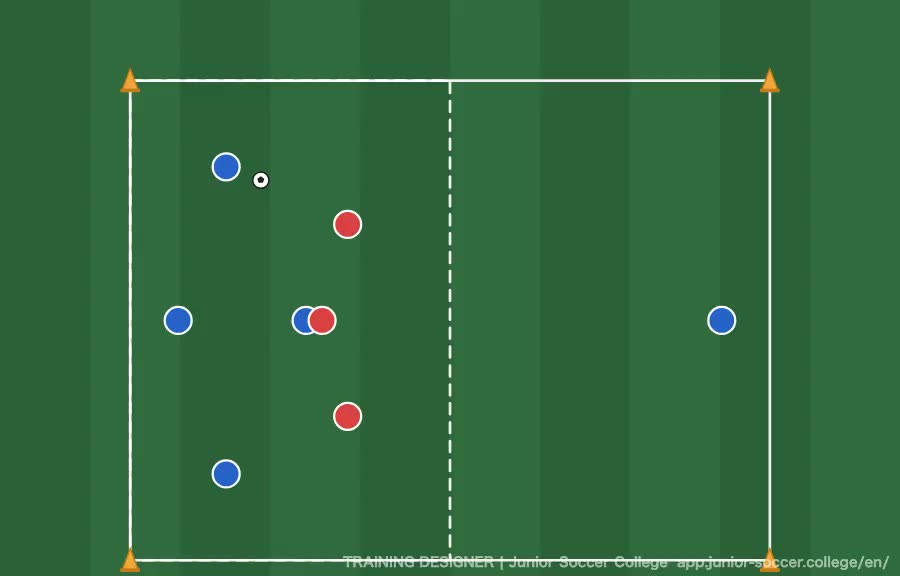
5v3 Possession (Directional) — The Basics of Pressing5+3 players · U-11 and up · Defending
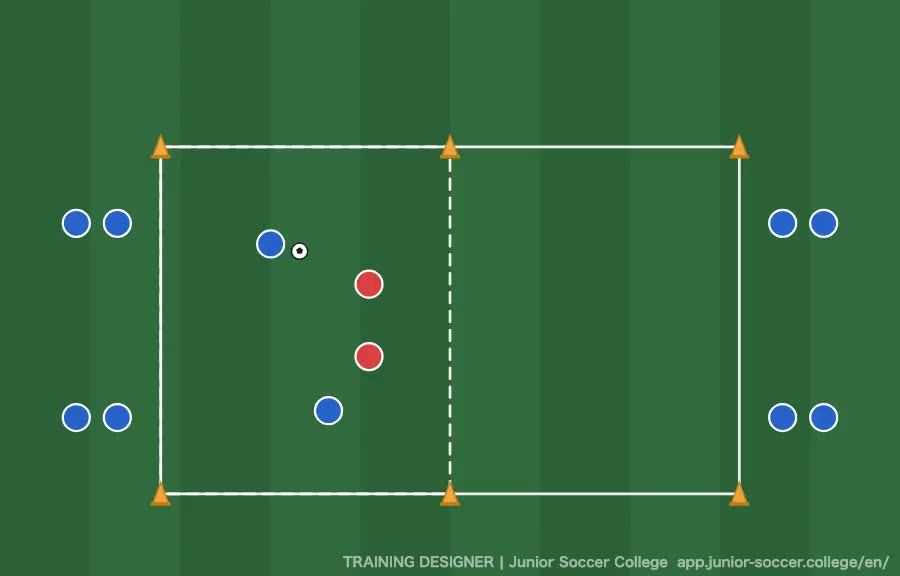
2v2 Attack + Third-Player Support — Delaying the Attack2+2 (12 players in total) players · U-9 and up · Defending
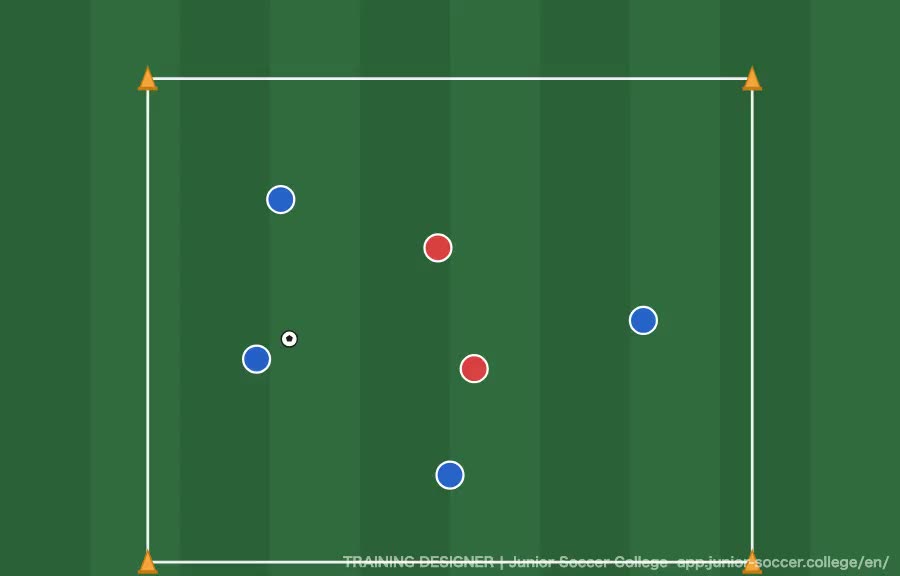
4v2 Rondo — Learning Challenge & Cover4+2 players · Any age · Defending
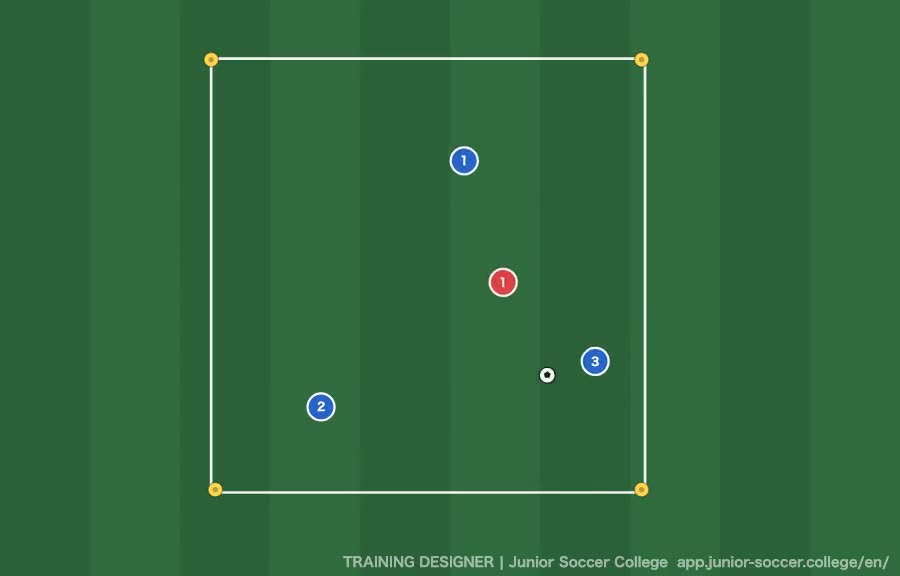
3v1 Rondo (Attack)4 players · U-7 · Keeping the ball
I'm Kazu — a youth football coach in Japan since 1995. These are sessions I actually use, shared from the Japanese coaching site I have run for years (Junior Soccer College). I also write a free weekly newsletter on how children learn the game.